Architecture’s New Brief: What Global Design Trends Mean for Students in Segovia
The most consequential shift in architecture and design is not a new aesthetic. It is a new brief.
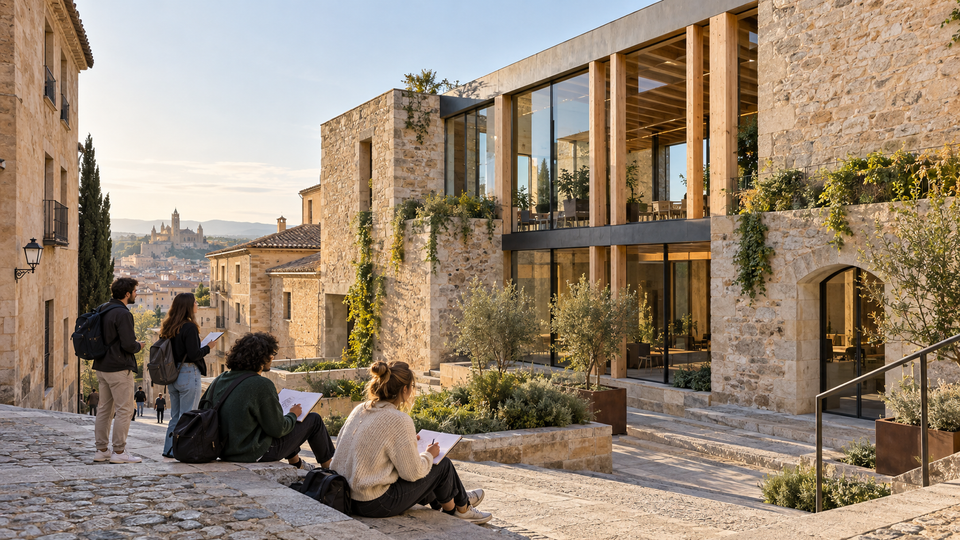
Across Europe, the work is moving beyond the isolated object or iconic building. Designers are being asked to make places that use fewer resources, adapt to a changing climate, welcome more kinds of people and still feel beautiful enough to belong to their communities. For architecture and design students in Segovia, that shift is especially tangible: this is a city where heritage is not an abstract reference but the everyday setting for study, movement and public life.
The environmental case is no longer optional. UNEP’s latest Global Status Report for Buildings and Construction estimates that the sector consumes 32% of global energy and accounts for 34% of global CO₂ emissions. Cement and steel alone are major sources of emissions, while construction produces vast quantities of waste. The practical implication is clear: the next generation of designers will be judged not only by what they add, but by what they preserve, reuse and avoid extracting.
That is why adaptive reuse has become one of the defining global directions. Instead of treating existing buildings as obstacles to redevelopment, architects increasingly treat them as material banks, social memory and climate assets. Retrofitting a structure, extending its life and improving its energy performance can be more intelligent than starting from zero. In a historic city like Segovia, this is not a niche discipline. It is a live question: how can contemporary uses enter older fabric without turning the city into either a museum or a generic product?
A second shift is circular design. The New European Bauhaus has made sustainability, beauty and inclusion a shared European vocabulary, but its relevance comes from practice rather than slogans. At the 2026 New European Bauhaus Trophy competition, student finalists proposed objects made with mycelium, recycled HDPE, hempcrete, recycled glass and rPET. They were assessed not just for concept and originality, but for feasibility, durability, production method and cost. That is a useful signal for students: the portfolio of the future needs to show both imagination and a credible material logic.
The third trend is an expanded understanding of design itself. Public space, housing, mobility, interfaces and services are increasingly designed as connected systems. The European Council’s 2026 recommendation on the New European Bauhaus places renovation, affordable quality housing, citizen participation, digitalisation and climate resilience in the same conversation. This matters because the most interesting design problems rarely arrive in one discipline. A housing project may demand spatial intelligence, social research, material choices, data tools and a way of listening to residents.
Digital tools are accelerating this change, particularly through AI-assisted visualisation, modelling and research. But their value is not automatic. Students who stand out will be those who can use technology to test options, communicate clearly and reduce repetitive work, while retaining authorship, judgement and accountability. A seductive render cannot answer whether a space is accessible, repairable, cool in a heatwave or welcome to the people who live beside it.
For the IE community, Segovia offers an unusually strong laboratory for this wider brief. The city teaches constraint: narrow streets, protected views, seasonal weather, tourism, stone, topography and a dense social life. These conditions invite precision. A good intervention here cannot be copied from a global Pinterest board. It must understand scale, maintenance, local materials and the rhythms of real users.
The opportunity is not to choose between global ambition and local sensitivity. It is to make them reinforce each other. The designers most needed now can move comfortably between a global climate target and a doorstep, between a digital model and a repair detail, between a bold idea and the people who must live with it.
For students beginning projects this term, a useful question may be simple: what does this proposal leave behind? If the answer includes less waste, more dignity, a longer useful life and a stronger sense of place, it is already responding to the architecture and design brief of the moment.
Sources:
UNEP, Global Status Report for Buildings and Construction 2024/2025: https://www.unep.org/resources/report/global-status-report-buildings-and-construction-20242025
European Commission, New European Bauhaus Trophy 2026: https://new-european-bauhaus.europa.eu/festival/neb-trophy-2026-design-competition_en
EU BUILD UP, Council Recommendation on the New European Bauhaus: https://build-up.ec.europa.eu/en/resources-and-tools/publications/council-recommendation-new-european-bauhaus-0
Member discussion