Segovia should build its next economy

Segovia’s next economy may begin with a change in what the city believes is possible. With the University of Valladolid and IE University here, it has an opportunity to connect local talent with international ideas, encourage more ambitious projects and make innovation part of everyday life. That influence could reach far beyond the people enrolled on either campus. But it needs to be cultivated over years.
A university changes a city through the relationships it creates. Students question familiar assumptions. Researchers bring new methods. Entrepreneurs test different ways of doing business. When those exchanges extend into schools, shops, workplaces and public institutions, they can gradually widen a city’s horizons. For Segovia, that is a compelling possibility: a more open outlook, a greater willingness to experiment and a stronger belief that a worthwhile idea can take root here.

IE’s international community gives this opportunity a particular character. People arriving with different experiences of business, investment and innovation can help local founders imagine customers, partners and possibilities beyond the province. The most valuable exchange would be reciprocal. Residents understand the city’s needs and its rhythms; incoming students and academics bring other perspectives. Working together could produce ideas that neither group would develop alone.
The University of Valladolid must be central to that exchange. Its María Zambrano campus and School of Computer Engineering belong in the same conversation about Segovia’s future. We would like to see more shared projects bringing UVa and IE students together with local employers, teachers and associations. A public university rooted in the region and an internationally connected university could offer complementary strengths, with each learning from the other.

Access matters. Spanish and local students should have meaningful opportunities to participate in this international environment. There is already a foundation to build on: the Diputación and IE’s 2026–2027 scholarship programme provides 54 awards for eligible students from the province, covering tuition and teaching fees. Renewals take priority, so that figure should not be mistaken for 54 new places each year. Recognising that existing commitment makes the next question more useful: how can its reach grow?
We propose expanding opportunities for new local applicants while protecting support for students already completing their degrees. That could include additional funded places, clearer outreach in secondary schools, application guidance, language preparation where needed and help with the practical costs of studying. Universities, public authorities, alumni and businesses should explore how to fund that expansion together. Talented young people should be able to see a route into these opportunities, whatever their family’s familiarity with international higher education.

The exchange should also reach people outside degree programmes. Open workshops, mentoring, mixed teams working on real local problems and accessible meetings with entrepreneurs could make university knowledge useful across the city. Imagine a Segovian business testing a new service with students from both institutions, or a young local founder meeting an experienced international mentor. Repeated encounters of that kind could make experimentation feel more familiar and attainable.
Its two universities can help Segovia become more curious about what comes next.
Over time, that could support more disruptive ideas: new services, different business models and solutions that challenge established habits. The test would be whether they solve a problem and find people willing to use or fund them. Segovia should give promising teams room to test, learn and try again, connecting technical skills with commercial knowledge and local experience.
Staying must be a choice supported by real prospects. Paid placements, early customers, suitable workspaces, housing people can afford and access to mentors or investors all matter. Local and international graduates should have reasons to build something in Segovia, and those who leave should find doors open if they wish to return or collaborate from elsewhere.
This is a long-term civic ambition. We should judge progress by the collaborations that endure, the local students who gain access, the businesses that try new approaches and the graduates who find a future here. Segovia can preserve the heritage it loves while becoming more curious about what comes next. Its two universities can help that change take hold—if the city and its campuses make a sustained effort to learn from one another.
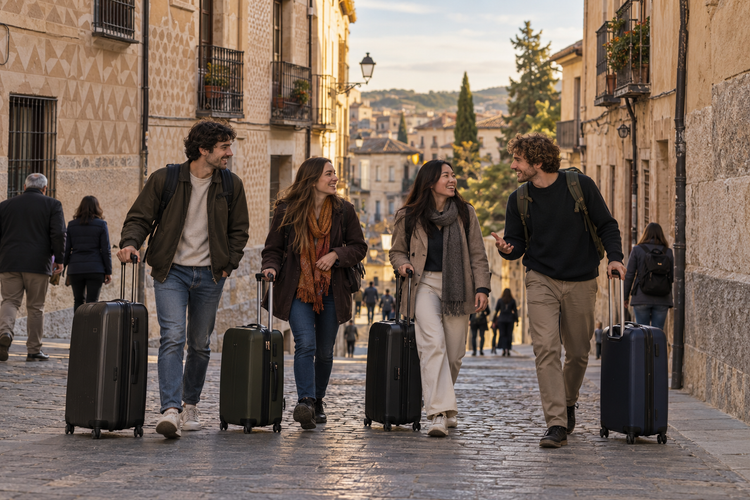
Cover: AI-assisted editorial photomontage by The Segovian, combining and transforming photographs by Savh and Sung Shin / Unsplash. Montage licensed under CC BY-SA 3.0.




Member discussion