IE & Segovia: It’s Time to Build a Shared Ecosystem
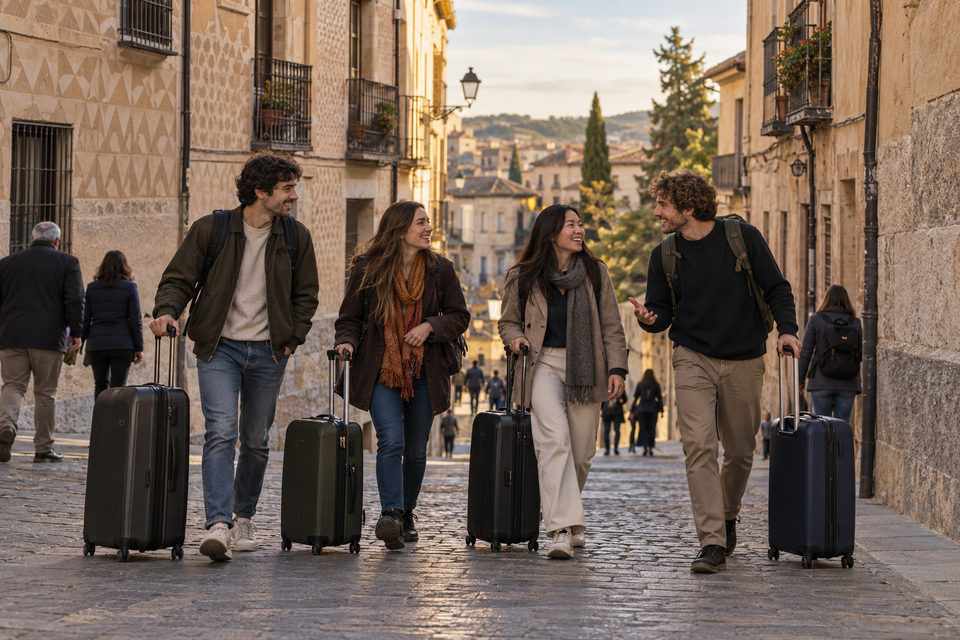
Segovia has an extraordinary combination of assets: a UNESCO-listed historic centre, proximity to Madrid, international tourism, IE University, the Universidad de Valladolid and an increasingly international community. Few cities of its size can bring so much history, knowledge and global connection into such close proximity.
The question is no longer whether Segovia should become international. It is how that internationalisation can create opportunities for the people who live and work here.
A city can welcome the world and still leave its own residents struggling to find a place in its future. Segovia should aim higher: an ecosystem in which talent, value and opportunity circulate between its communities.
What housing tells us
Housing makes the imbalance visible. Idealista’s September 2026 report puts advertised rents at €13.40 per square metre across Segovia and €16.10 in Plaza Mayor–San Agustín. These are asking-price indicators, not the rents paid under every existing contract.
In July, IE’s rector reported around 1,800 students in Segovia, with approximately 1,200 living in private flats, occupying an estimated 400–500 homes. Those university estimates, reported by Europa Press, describe a meaningful source of demand in a small market. They do not establish how much of any rent increase it causes.
The incentive is easy to understand. Consider an illustrative flat that could rent to a family for €1,000 a month. If three students can each pay €700–€900, its potential gross monthly income becomes €2,100–€2,700, before expenses, vacancies or differences in services. This is a hypothetical comparison, not a claim about typical room prices.
Households relying on local earnings may struggle to compete with those combined budgets. But owners do not all make the same calculation. Some prefer families, continuity and longer contracts, even at a lower return.
No villain is needed to explain the pressure. Housing reveals a wider economic imbalance: purchasing power can arrive faster than residents’ earning opportunities improve.
From spending to opportunity
More property value, consumption, tourism and international visibility can bring real benefits. The risk is that they expand without a corresponding increase in skilled employment, productive businesses, innovation and better wages.
This is a question of economic structure and incentives. If Segovia mostly provides accommodation, meals and short stays, it captures only part of the value passing through it. The ambition should be to help residents create, manage and retain more of that value.
The greater ambition is to make opportunity circulate.
IE is an opportunity here. It brings students, academics, entrepreneurs and global networks into the city. An international university brings talent to a city. The greater ambition is to make opportunity circulate.
There are already foundations to build on. SegoviUp 2026 brought together the provincial government, IE University and GBO around entrepreneurship and innovation. The task is to turn connections like these into sustained relationships that more local businesses can access.
Imagine paid student placements in Segovian companies; projects helping shops and artisans reach new customers; professors advising businesses on international expansion; and founders choosing to establish startups here. Architecture, culture, tourism and technology could become fields of shared work, with clear benefits for participating residents.
These projects need continuity, accessible entry points and practical outcomes. A small business should know whom to approach, what help is available and what commitment is expected.
A student who spends formative years in Segovia should leave with more than a degree and memories of Plaza Mayor. They should have had the chance to become part of the city.
A university city, together
This conversation must also include the Universidad de Valladolid’s María Zambrano campus. Between UVa and IE, Segovia has a significant concentration of students, teachers and knowledge. Why does Segovia still not fully feel like a university city?
The answer cannot be another isolated initiative. Shared projects, public lectures, cultural programmes and business partnerships should make university life more accessible beyond campus, while giving students a reason to engage beyond their own circles.
Housing belongs within that effort: more private homes and university accommodation, rehabilitation of empty properties, affordable housing and public-private collaboration. Better access to finance for creditworthy young buyers can help, alongside higher productivity and wages. Each addresses a different constraint. There is no single culprit, and no single solution.
Segovia should not become less international. It should become better at being international.
That means measuring success by more than arrivals, spending or property prices. It means asking whether residents gain opportunities, businesses gain capabilities and newcomers gain meaningful connections.
What can Segovians and their international neighbours build together that neither could build alone?

Member discussion